If you are searching Amazon for the best couch cleaner, the most important question is not which bottle has the highest rating. As the owner-operator of a professional upholstery cleaning company, I would first want to know what your couch is made of and what you are trying to remove. For homeowners in Everett, those two details matter far more than the product name.
Amazon has hundreds of upholstery sprays, stain removers, shampoos, and small extraction machines. Many have thousands of positive reviews. That still does not mean a highly rated cleaner is appropriate for every sofa, because upholstery fabrics and stains can respond very differently to the same product.
Why the Best Couch Cleaner Depends on the Fabric
A polyester sofa and a sofa made with cotton, linen, wool, viscose, or another natural fiber should not automatically be cleaned with the same product. Choosing a cleaner before identifying the fabric is one of the biggest problems with DIY upholstery cleaning.
Someone may see a cleaner with excellent reviews, spray it onto a couch, scrub the stain, and get a good result. But another fabric may react differently. The original stain can become less important than a water ring, discoloration, residue, color loss, or a larger visible spot created during the cleaning attempt.
That does not necessarily mean the cleaner itself was bad. It may simply have been the wrong product or the wrong process for that particular upholstery. Natural fibers can require especially careful decisions, which is why cleaning a cotton sofa is not the same as treating every synthetic couch with a general-purpose product.
The Best Couch Cleaner Also Depends on the Stain
The second question is what you are trying to remove. Coffee, food, body oils, pet urine, ink, paint, makeup, grease, and ordinary soil are different cleaning problems. There is not one product I would choose for every one of them.
An oily spot may require a different approach from a coffee stain. Pet urine treatment may need enough contact time to work on the contamination rather than simply changing the smell. Ink, paint, adhesive, and permanent marker may require completely different spotting products.
This is also why buying the strongest-looking cleaner is not necessarily the safest approach. Stronger does not automatically mean better when the fabric itself may be sensitive to moisture or chemistry. Difficult stains such as permanent marker on a couch are a good example of why the stain type matters before choosing what to apply.
Why the Best Couch Cleaner Is Only Part of the Process
The biggest DIY problem is often not applying the cleaner. It is removing it afterward.
People commonly spray a product onto the fabric, scrub it with a towel or brush, see that the stain looks lighter, and consider the job finished. But some of that cleaning solution may still remain inside the upholstery.
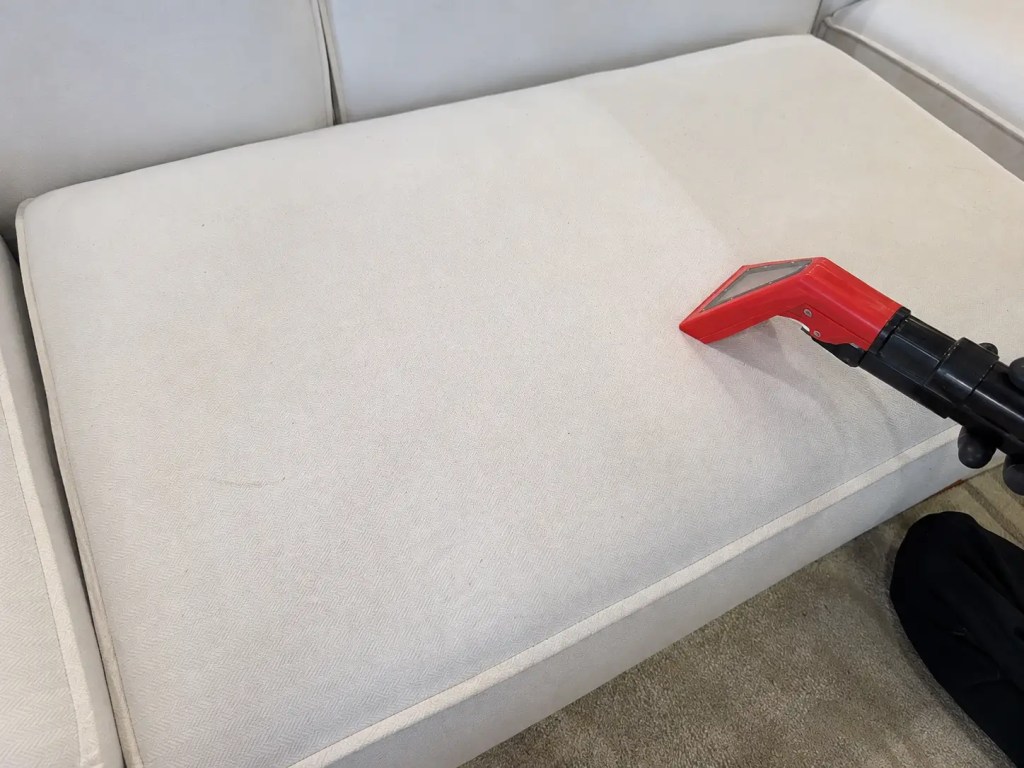
When I professionally clean upholstery, applying the cleaning solution is only one part of the process. The fabric then needs appropriate rinsing and extraction. Leaving too much cleaning residue behind may cause the treated area to attract soil faster and can create additional problems depending on the fabric and the chemistry used.
This is one of the differences between simply treating the visible surface and a more complete process. My explanation of deep upholstery cleaning versus surface cleaning goes into more detail about why the steps after applying the cleaner matter.
What Would I Actually Buy on Amazon?
If you are asking for one bottle that I can confidently recommend for every sofa, every stain, and every fabric, I would not choose one universal product.
Instead, start by finding the manufacturer’s cleaning information for your couch. If possible, determine the actual fiber content of the upholstery, such as polyester, nylon, cotton, linen, viscose, wool, or a blend. Then identify what caused the stain.
Only after those two questions are answered does it make sense to choose a cleaning product.
For a small, fresh spill on a water-cleanable synthetic fabric, the safest first step may be much simpler than expected. A clean white towel, a small amount of water, and careful blotting may be enough. Avoid aggressive scrubbing. Use pressing and blotting motions, moving to a clean part of the towel as contamination transfers out of the fabric.
A real sofa cleaning job involving a coffee stain also shows why the type of contamination should guide the treatment rather than choosing one cleaner for everything.
What About a Small Upholstery Extraction Machine?
Portable extraction machines can be useful for homeowners, but the machine does not solve the chemistry problem. You still need to know whether the fabric can safely be wet cleaned, what solution you are applying, how much moisture you are using, and how completely you can extract it afterward.
Overwetting upholstery can create problems of its own, particularly when cushions contain foam or when the fabric is more sensitive to moisture. Owning an extractor therefore does not remove the need to identify the upholstery before cleaning the entire couch.
If you do not know the fabric type, or you are dealing with an expensive sofa, natural fibers, an old stain, pet urine, ink, paint, or an area already treated with several household products, stopping before further experimentation may be the safer choice. A removable stain is usually preferable to damage caused by an unsuitable cleaning attempt.
If you are unsure what cleaner is appropriate for your couch in Everett, I can evaluate the upholstery, the type of contamination, and the condition of the fabric before recommending a realistic cleaning approach.
FAQ About Choosing the Best Couch Cleaner
Is there one best couch cleaner for every sofa?
No. The appropriate cleaner depends on the upholstery fiber, the type of stain, and the cleaning process required to remove both the contamination and the cleaning solution afterward.
Should I choose the strongest upholstery cleaner?
Not automatically. A stronger product may be unnecessary or unsuitable for a particular fabric. Start with the couch manufacturer’s cleaning guidance and identify the stain before choosing chemistry.
Can I use water on a fresh couch spill?
For a small fresh spill on a water-cleanable synthetic fabric, careful blotting with a slightly damp clean white towel may be enough. Avoid aggressive scrubbing.
Do portable couch cleaning machines make DIY cleaning safe?
They can be useful, but you still need to know whether the fabric can be wet cleaned, which solution is appropriate, how much moisture to apply, and how thoroughly to extract it.